Everyone has financial goals, but many of us have a hard time achieving them. Whether you’re saving up for a major purchase or an event, building an emergency fund, or trying to get out of debt, we know how hard it can be to keep those goals in mind when you’re busy working, taking care of your family, and doing other things. Many people discover that a 30-day savings challenge can get them on the right financial path because it starts out being “just” for 30 days, but it often turns into longer-term habits that help them save more money through the rest of the year and beyond.
Try to get your whole family involved and make it a team effort. If you have kids in the house, this is a great way to teach them about fiscal responsibility and help them establish good spending and saving habits. Make sure they understand that there are costs and benefits to every financial decision you make and explain to them the importance of saving up for a goal, whether it’s a family vacation, improvements to your home, or a major purchase. You might come up with an affordable way to reward yourselves after you meet these goals, such as dinner at a favorite restaurant. Just make sure that your celebration doesn’t undo the progress you’ve made with these savings challenges.
A 30-day savings challenge is a way of taking a long-term financial goal and turning it into a bite-sized chunk that makes it easier to follow. It’s one of the more popular fun financial challenges because it helps you learn how to save money and set yourself up for success.
Think of all the New Year’s resolutions that people make but soon forget. For many of us, that resolution lasts for about a month. A month-long savings challenge seems much easier to accomplish than a year-long commitment to meet a particular goal. Hopefully, by the time your 30 days are up, you’ll be able to see what you’ve accomplished and use that to motivate yourself to stick with your goals for the rest of the year.

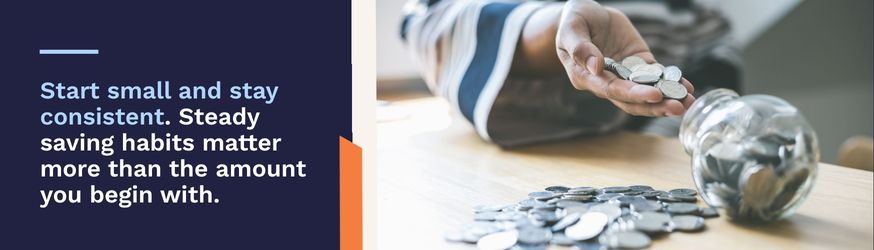
There are many ways to initiate a 30-day savings challenge. We recommend starting small, such as saving a particular amount each day. You might start off saving $1 on your first day, then $2 the next day, and increase that amount each day through the end of the month. This way, you can start with a goal that’s easy to achieve and build momentum through the rest of the month. Another approach would be to save the same amount each day, such as $5 or $10.
Keep track of your spending each day—which is another 30-day challenge you might try. You could do this using a pen and paper, an app on your phone, or whatever works for you. The idea is that by sitting down and thinking about where your money goes, you can look for ways to spend less and save more. A morning cup of coffee and a donut on your way to work don’t seem like much on a one-time basis, but you might be surprised how quickly those costs add up.
This is why keeping track of your spending can help you save, because you realize how much these expenses are really costing you over the long run. Try to cut at least one item from your daily spending routine as a way of meeting your 30-day goals. You could also consider pausing or canceling any streaming services you use when you’re not really using them. Monthly expenses like these should be included when you track your spending.

You might open a separate savings account where you transfer all the funds you’ve saved each day. If that seems inconvenient, try doing it at the end of each week so you can track your progress and motivate yourself to keep going. If saving something each day seems unattainable, there are other approaches to the 30-day challenge that you might consider.
Of course, there’s more than one approach to the 30-day savings challenge. These might seem a bit harder to achieve, but each of them can have a dramatic impact in helping you meet your savings goals.
A “no-spending month” starts with a close look at your budget. If you’ve never created one, consider doing so as part of your 30-day challenge. Make a list of all your essential expenses such as your rent or mortgage, groceries, utilities, insurance, and transportation—and only spend on those categories. You may need to stock up on groceries ahead of time and plan, such as making your lunch at home and bringing a thermos full of homebrewed coffee to work. If this seems too difficult, try doing it for one or two days. You may discover that it’s not as hard as you thought, and you can use the money you save as a way of motivating yourself to continue. A variation on this would be the “no spending weekend,” where you refrain from spending on anything over the weekend apart from essentials (such as the grocery store). You could also take a close look at your pantry and freezer to plan for homemade meals that don’t require spending much at the store.
With this challenge, any time you come across something you “want” but don’t actually “need,” you put off buying it for 30 days. Impulse purchases can be hard to avoid when you can just click and add something to your cart when shopping online, or when you see something on sale in a store. Part of this challenge would be to make a list of all your essential purchases before you do your grocery shopping, to help you avoid impulsive purchases. Instead of buying something on reflex, keep a list of each item, including how much it costs, where you found it, and the date.
Over the next 30 days, save up for that purchase by setting money aside and cutting back your spending in other areas. After 30 days, if you still want that item, you’ll have saved up for it to reduce its impact on your budget. If you realize that you don’t really need it, that’s great. You’ll have avoided an unnecessary purchase and saved money that you could put to other uses. When 30 days are over, consider using this approach to curb any impulse buys in the future to help you meet your financial goals.
If the 30-day challenge doesn’t appeal to you, you might consider these other savings tips for 2026. Of course, you could also try the30-day challenge, and once you’ve completed it, give these other challenges a try. The idea here is to build healthy spending and savings habits that could improve your life beyond 30 days.
Many people have a jar of change at home that they add to each night when they empty their pockets. A roundup app works in a similar way. You connect it to your accounts, and for any purchases you make using a credit card or debit card, the app automatically rounds up what you’re spending and deposits the extra into a savings account. For example, if you spend $5.50 on something, the app would charge $6.00 and deposit the extra $0.50 into whichever account you choose.
This one is similar to the roundup challenge and your jar of change. With this one, you use cash for spending instead of a credit or debit card. Every time you have a $5, you set it aside and avoid spending it. As you collect these $5 bills, you might put them in a different pocket, so you don’t accidentally spend them.
Make a list of all your monthly streaming services and subscriptions, add them up, and multiply by 12. A monthly subscription might not seem like much of an expense until you consider what it’s costing you each year. You should also take a close look at how often you actually use these services. Many people sign up for a streaming service to watch a particular show or a movie, then soon forget about it. If cutting all your subscriptions at once seems impossible, just remind yourself that it’s only for a month. Some people meet this challenge by cutting their subscriptions for a month, then they only subscribe to one streaming service at a time. If your family is itching for activities, try renting movies from your local library (for free) or try other activities such as game nights, exercise, or reading a good book.
This one is a little more involved and lasts more than 30 days. You buy 100 envelopes and number each of them from 1 to 100. Give them a shuffle and place them in a box in a way that you can’t see the numbers. Each day, you pull an envelope, and whatever number is on the envelope is the amount of cash you’ll need to save that day. Of course, you could also do this by numbering slips of paper, folding them so you can’t see the numbers, and pulling one of them out of a hat each day. Those larger numbers could be a challenge, but that’s the idea. It gets you thinking about ways to curb your spending or raise some extra revenue. You might have some items around the house that you could sell, a subscription you could cancel, or a side gig where you could earn some cash. If you complete this challenge, you’ll have raised $5,050.

While these challenges are a great way to improve your financial health, there are also things to consider for meeting your financial goals:
Our online portal and mobile banking app make it easy to help you track your progress, transfer funds, and meet your goals. You might consider using a checking account for depositing checks, paying your bills, and withdrawing cash, with automatic transfers to your savings account as a way to help you save. Stop by or call a branch location in and around Houston, Austin, Galveston, Lake Jackson, New Braunfels, or Pasadena today to speak to a member of our team, or open a savings account online today!