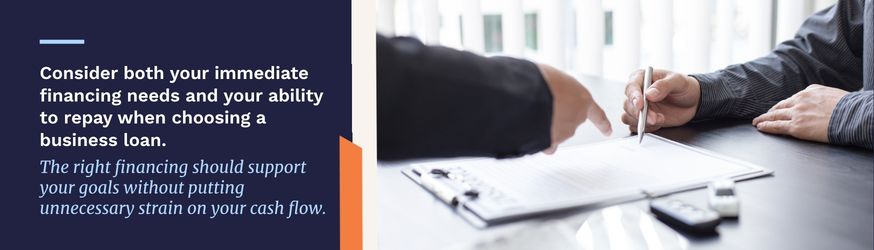
There are several types of business loans in Texas, such as commercial business loans and business lines of credit, as well as those backed by the Small Business Administration (SBA). Choosing the right one for your business depends on how much you need to borrow, the terms you’re looking for, and how you’ll use the funds.
Choosing the right kind of small business financing is important because you need to match the right loan with your business needs, as well as your ability to obtain and repay the loan. Traditional bank loans are often used by established businesses because they’re faster to obtain. SBA loans have a longer application process but may offer lower interest rates and more flexible lending requirements. They’re often used by newer businesses and startups.
Whether you need funds for working capital, to buy equipment, invest in real estate, or a flexible pool of funds, you have several business loans to choose from.
A term business loan is one issued by your local bank and can be used to fund a variety of needs. You might use a term business loan as a source of working capital, to launch or expand a business, or to refinance your business debts.
An equipment financing loan can be used to purchase business equipment such as machinery, business vehicles, computers, servers, and related devices including office furniture. With equipment financing, the product you’re buying serves as collateral.
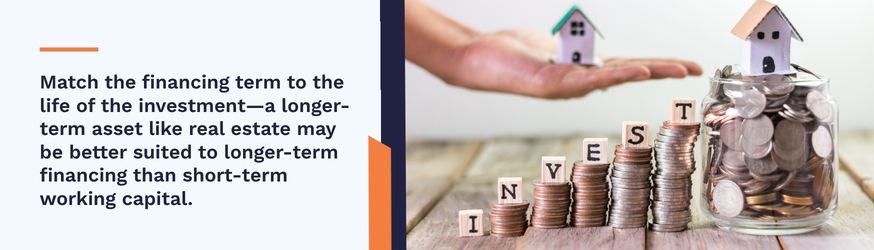
You could use a commercial real estate loan to buy a business property that you intend to occupy or to lease out as a source of income. It could be used to buy any number of business properties such as retail buildings, warehouses, and apartment buildings. The property you’re buying would serve as collateral, and interest rates could be fixed or variable. You might also choose between a loan that’s fully amortized with steady loan payments or make interest-only payments with a balloon payment at the end of the term.
A commercial construction loan could be used to expand an existing building or to buy land and build a business property. With construction loans, you would make interest-only payments during the construction phase and when it’s complete, your loan would convert to a commercial mortgage, and you would start to pay off the loan. A commercial construction loan can be used to build a variety of commercial and business properties.
A business line of credit, also known as commercial lines of credit, is a flexible lending solution that businesses use to cover many of their financial needs. When you set up a line of credit, it’s available whenever you need and you only pay interest on what you borrow, starting from the moment you draw on these funds. After you pay back the loan, you could access these funds again to meet some future need. You might use a line of credit to cover an income shortfall during a seasonal slump in revenues or delayed payments from customers, to buy equipment and supplies in advance of an expected surge in business or to fulfill a contract, and to pay for emergency repairs or replacing equipment.
In addition to traditional bank loans, we also provide loans backed by the Small Business Administration (SBA). These loans are issued by banks and backed by the SBA. They’re typically used by small businesses that might have trouble obtaining financing through other means. They’re popular among newer businesses because they offer lower interest rates than traditional bank loans as well as low down payments, longer terms, and more flexible qualification requirements.
SBA7(a) Loans are the most popular type of SBA loan and can be used to fund a variety of business needs such as working capital, debt refinancing, obtaining inventories, and buying a business, real estate, or equipment. Loans of up to $5 million are available with 10-year terms at fixed or variable interest rates, and borrowers must provide collateral. If a 7(a) loan is used to finance or refinance something with a useful life of 10 years or more (such as real estate or equipment) the term could be extended to 11 years. The portion of a7(a) loan that’s used to buy or improve a property could have a term of up to 25 years.
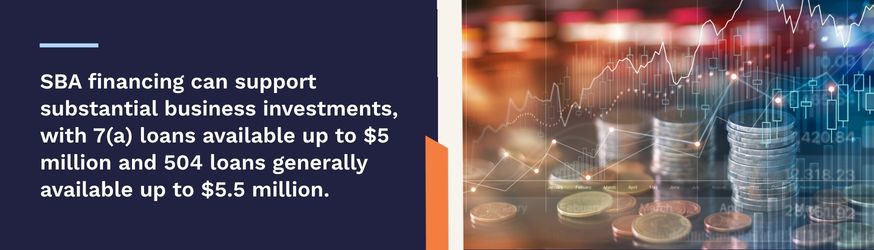
SBA 504 Loans are used for buying or improving fixed assets with a useful life of 10 years or more, such as business properties, land, and equipment. A 504 recipient can borrow up to $5.5 million at fixed interest rates with terms of up to 25 years. These loans can also be used to improve or modernize a commercial property and cover up to 90% of a project’s cost. With 504 loans, the asset you’re buying with the proceeds serves as collateral.
With an SBA Express Loan, recipients can borrow up to $500,000 with terms of up to 10 years. The proceeds can be used for a variety of business needs such as working capital, starting a new business, or to buy equipment and inventories. Express loans offer fast loan approvals that are often granted within 36 hours.
With an SBA Microloan, small businesses and some nonprofit childcare centers can borrow up to $50,000 for working capital, supplies, and machinery. These loans can’t be used to payoff existing debts or buy real estate.
When considering the type of small business financing you need, start by figuring out how much you need to borrow and what you’ll use it for. If you need the money to buy something tangible, such as real estate or equipment, then a commercial real estate loan, a construction loan, or an SBA7(a) or a 504 loan might work for you. If you need a flexible pool of funds, you might consider a business line of credit. Of course, you’ll also have to decide whether to pursue a traditional term loan with a bank or a loan backed by the SBA.
With SBA loans, you could borrow up to $5 million through a7(a) loan or $5.5 million from a 504 loan. SBA-backed loans typically offer lower interest rates and longer repayment terms than traditional term loans. Bank loans offer shorter terms and higher monthly payments. SBA loans also require more paperwork and have a longer approval time. With Moody Bank, we make all our lending decisions locally so we can offer faster approvals than you would receive from the SBA and from many other banks.
One advantage that SBA loans have over bank term loans is that SBA loans typically have looser eligibility requirements and are easier for businesses to qualify if they can’t obtain a traditional bank loan.
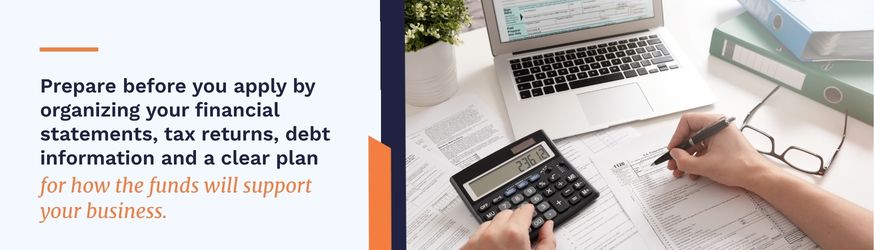
When applying for a small business loan in Texas, a lender might want a business plan that explains who you are, what your business does, and your plans for growing your business, such as your marketing strategy. The SBA’s website has information on how to write a business plan and on business planning.
A lender will also want to know your plans for how you’ll use the proceeds from your loan and documents that show your business income, business assets, and possibly your personal assets as well. A lender will want to see:
• A full year’s worth of bank statements for your business.
• A government-issued photo ID, your proof of address and Social Security number.
• Your business and personal income tax returns for the past three years.
• Your business income and cash flow.
• Current account balance sheets and projections for your business.
• Accounts receivable.
• Documentation of all your business debts and assets.
• Incorporation papers (for partnerships and LLCs).
• Your franchise agreement (if you’re a franchisee).
• Proof of your employer identification number (EIN), also known as a Federal Tax Identification Number. This is required if you have one or more employees, or if you operate your business as a corporation or partnership.
A lender might also ask to see your proof of business registration. In Texas, businesses are required to register with the Texas Secretary of State or your local county clerk’s office. If you’re a sole proprietor our partnership and running your business under a name that’s other than your own, a “doing business as” (DBA) name, this must be registered with the state or your county clerk.
If you’re looking for a business loan in Texas and want to explore your options, please contact us online or visit one of our many locations in Houston, Austin, Friendswood, Galveston, Lake Jackson, Montgomery, New Braunfels, Pasadena, Seabrook, Pearland, League City, Texas City, Sugar Land, and Dickinson.